

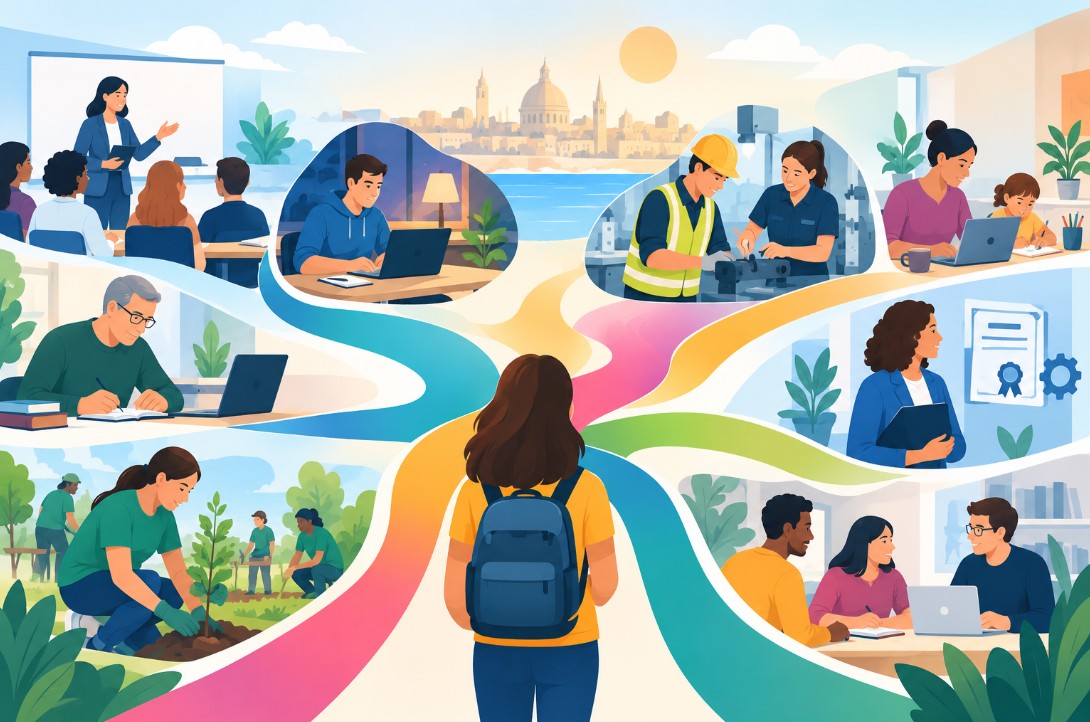
Education rarely happens in just one place, at one moment in life, or in one particular way. For most people, learning doesn’t stop when school ends; it continues quietly alongside work, family life, and everything else that fills the years afterwards.
We usually imagine education as a straight path: school, followed by college or university, then earning a qualification, and finally it’s complete. However, real life rarely follows this simple trajectory. Some individuals begin working at a young age, while others return to study after many years. Many people manage both work and study simultaneously for extended periods.
With the International Day of Democracy having just passed, it’s a good moment to look at how the Malta Qualifications Framework (MQF) makes room for these different routes, and why that flexibility matters for building a fairer, more inclusive society.
Judging what people can actually do
At its core, the MQF is built on a simple idea: what matters most is what a person knows and can do, not how they got there.
That might sound obvious, but it’s a genuine shift in thinking. Some people learn through a traditional academic path. Others acquire knowledge and skills through years on the job, apprenticeships, evening classes squeezed in after work, or simply through the accumulated experience of life itself. The MQF brings all of these into a single national framework, so that achievement can be recognised wherever it happens, not just in a classroom.
Fitting learning around life, not the other way around
For some people, education must bend around everything else going on in their lives, not the reverse.
Someone might work all day and study at night. Someone else might be raising children while chipping away at a part-time course. Another person might step back into education after years away, bringing a decade of hard-won experience with them. Evening classes, part-time study, and other flexible options exist precisely so people don’t have to choose between earning a living and continuing to grow.
That’s really what lifelong learning means in practice: giving people the chance to develop, reskill, and move forward at whatever stage of life they happen to be in.
Learning on the job
The workplace itself can be one of the richest places to learn.
Work-based learning allows people build knowledge and skill in real, live situations, not hypothetical ones. It’s learning by doing: applying an idea, seeing how it holds up against an actual problem, and adjusting from there.
Apprenticeships are a good example of this in action, blending structured teaching with genuine hands-on experience.
It’s a useful reminder that a classroom isn’t the only place where real learning happens. Practical, on-the-ground experience can shape a person just as powerfully, especially when it’s structured properly, assessed fairly, and formally recognised.
Giving credit for learning that already happened
Not every skill comes with a certificate attached.
People pick up knowledge through their jobs, volunteering, community work, hobbies, and the ordinary business of everyday life. Much of the time, they wouldn’t even think to call it “learning” but it shapes what they know and what they’re capable of all the same.
This is where Recognition of Prior Learning (RPL) comes in. It offers a formal way of acknowledging skills and knowledge a person has already built up through experience, even without a paper qualification to show for it. That matters a great deal for adults who’ve spent years working and growing professionally but never picked up a certificate that reflects it. RPL measures that experience against established standards, effectively building a bridge between what someone already knows and wherever they want to go next.
Different roads, one shared map
None of this means every qualification or learning experience is interchangeable, they still differ in purpose, content, and how they’re assessed, and those differences matter. What the MQF offers instead is a shared reference point: a way of describing, level by level, what a learner should know and be able to do, regardless of the path that got them there.
One person might reach a given level through a university degree. Another might arrive at the very same point through an apprenticeship, part-time study, or years of relevant work recognised through RPL. Different roads, but each one representing real effort to learn and move forward.
Why it matters
Education gives people the tools to take part in work, in their communities, and in public life. But not everyone has equal access to it. Circumstances, responsibilities, and opportunities differ enormously from person to person.
For some, a full-time academic programme will always be the right fit. For others, an apprenticeship, an evening course, on-the-job learning, or recognition of prior experience will make far more sense. None of that lowers the bar; it simply acknowledges that people can meet the same standard by very different routes.
There doesn’t need to be one single path into education. What actually matters is that people get a real chance to learn, that what they achieve is properly recognised, and that they can keep growing throughout their lives, whether that begins in a classroom, on the job, out in the world, or simply with a decision, one day, to learn something new.
This is central to the role of the Malta Further and Higher Education Authority (MFHEA). As the Authority responsible for quality assurance and the regulation of further and higher education in Malta, we have a role to play in ensuring that different routes to learning are supported by clear standards, meaningful recognition, and confidence in the quality of the education and training provided. In doing so, we can help create an education system that recognises different starting points and pathways, while ensuring that quality remains at its core.