Skip to content
A A A
  • Provider relations
  • Media relations
  • Applications
    • Provider Accreditation (Licensing)
    • Programme Accreditation
    • Academic Qualifications
Malta Further & Higher Education Authority Logo Malta Further & Higher Education Authority Logo
  • About Us
    • Overview
    • Timeline
    • Organisational Structure
    • MFHEA Board Members
    • Quality Assurance Committee
    • Employment Opportunities
  • Our Services
    • Client Service Charter
    • MQRIC
      • Academic Qualifications
      • ENIC-NARIC Projects
    • Mutual Recognition of Professions
      • Professional Qualifications
      • European Professional Card
    • Provider Accreditation (Licensing)
      • List of Licensed Providers and Accredited Programmes
    • Programme Accreditation
      • List of Licensed Providers and Accredited Programmes
    • Quality Assurance
      • Quality Assurance Overview
      • National Quality Assurance Framework
      • External Quality Assurance
      • QA Publications
      • QA Events
    • VNFIL
      • Validation
      • National Occupational Standards
    • Compliance
  • Research
    • Overview
    • FHE Statistics
    • Projects
  • Resources
    • Support
      • Providers
      • Employers & Human Resources
      • Educators & Guidance Educators
      • Students and Learners
    • Referencing Report
    • The Gender Equality Plan
    • Malta Qualifications Framework
    • Strategies
    • Legislation
    • Publications
    • Useful Links
  • Announcements
  • Contact
  1. Home
  2. Media relations
  3. Six Values, One Europe: What Holds Higher Education Together
  • View Larger Image

Six Values, One Europe: What Holds Higher Education Together

A quick guide to the fundamental values of the European Higher Education Area, ahead of the event on Institutional Autonomy in Malta, 13–14 October 2026

Behind every degree awarded and every lecture delivered in Europe lies a shared set of principles. The countries of the European Higher Education Area (EHEA) have committed to fundamental values that safeguard the integrity, independence and public purpose of higher education. This note outlines the essentials for journalists, stakeholders and anyone following the discussions in Malta this October.

The six fundamental values

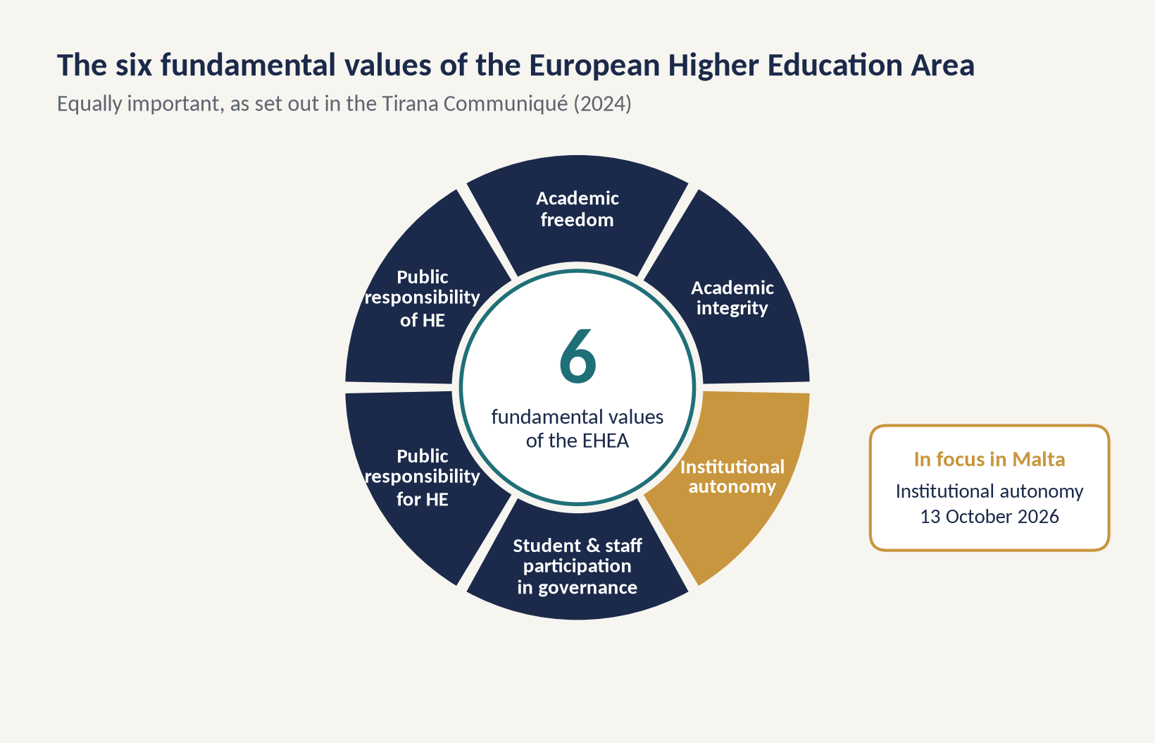
Ministers have made explicit a shared understanding of six values, which are regarded as equally important[1].

  • Academic freedom: the freedom of academic staff and students to teach, learn, research and share knowledge without undue interference.
  • Academic integrity: honest, responsible and ethical behaviour across teaching, learning and research.
  • Institutional autonomy: the ability of higher education institutions to make decisions about their internal organisation and their academic, administrative and financial affairs, within the relevant legal and regulatory frameworks.
  • Student and staff participation in governance: students and staff having a genuine voice in how their institutions are run.
  • Public responsibility for higher education: the duty of public authorities to ensure a sound framework for higher education.
  • Public responsibility of higher education: the responsibility of higher education to serve society and contribute to the public good.

[1]EHEA Ministerial Conference, Tirana 2024, Annex I – Statements on Fundamental Values: https://www.eqar.eu/assets/uploads/2024/06/ANNEX-1-EHEA-STATEMENTS-ON-FUNDAMENTAL-VALUES.pdf
Why fundamental values matter for education

  • They build trust: shared values give students, employers and the public confidence in the quality of qualifications across Europe.
  • They protect quality: autonomy and quality assurance go hand in hand, supporting trust, responsibility and resilience within the EHEA.
  • They serve the public good: universities are increasingly understood as public goods whose governance matters well beyond the campus.
  • They depend on everyone: effective application involves institutions, students, staff, quality assurance agencies and public authorities alike.
  • They must be monitored: the EHEA is moving from commitment to implementation, with frameworks to monitor how values are upheld in practice.


ENDS


*AI-generated images for illustrative purposes.

By Theodora Bond|2026-10-08T14:00:59+01:0008/10/2026|Media relations|0 Comments
  • Terms of use
  • Data protection
  • Contact Us

Malta Further and Higher Education Authority (MFHEA), Triq J Abela Scolaro, Hamrun. HMR 1304 - Malta

Phone: MFHEA Tel: +356 2598 1489 / MQRIC Tel: +356 2598 1450

logo

© 2020 All rights reserved. Reproduction in whole or part is strictly
prohibited without the written permission of MFHEA

2020 All rights Reserved, Design & Developed by 4sight
Page load link
Go to Top